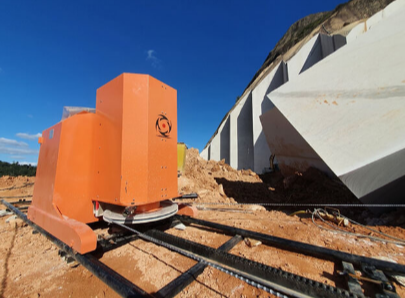
The current mining operations can be described as facing numerous and varied challenges, from harder rock formations to tighter project timelines to increased scrutiny of safety and environmental concerns. The current methods of mining through blasting and impact-based techniques are not working sufficiently to cut the rock into manageable pieces. The importance of rock cutters in mining operations can therefore not be overemphasized.
Unlike the disruptive methods of excavation, rock cutting technology facilitates an orderly and methodical approach to cutting, thus its use in underground and surface mining situations.
The Engineering Principle Behind Rock Cutting Systems
Rock cutting technology uses a continuous mechanical cutting process. This involves cutting drums that rotate while they cut into the rock surfaces. Instead of breaking into fragments, these cutters penetrate into rock surfaces in a gradual manner. This allows cutting speed and depth to change in line with the varying rock hardness.
As an engineering process, the use of this system minimizes stress concentrations in the rock mass. The overall effect of the process is a smooth excavation profile and the reduction of the possibility of spurious fractures. Spurious fractures often occur in systems that use the impact-based excavation methods. The technology would be effective in mixed ground where the achievement of consistency is a problem.
What Rock Cutters Do to Enhance Mining Productivity at the Process Level
The productivity benefits of rock cutters go beyond the rate of excavation, with their main advantage being process optimization. Continuous cutting eliminates time lost in drilling, blasting, clearance, scaling, and all other associated downtime. This allows mining to take place continuously.
Accurate cutting minimizes overbreak by removing only the required material, which reduces waste movement and transportation costs. This eventually translates to cost savings based on fuel, equipment, and labor usage. With space or movement limitations, adding a skid steer rock crusher helps streamline workflow by allowing for material processing.
Moreover, the ability to perform multiple functions such as trenching, profiling, and controlled scaling within one attachment can lead to increased equipment utilization.
Safety Advantages Rooted in Controlled Excavation
The safety improvements are not procedural changes, and the key benefit of reducing vibration plays an important part in rock stability, particularly in underground mining, where rock formations can be semi-loose and not supported.
With fewer levels of vibration, the risks of rockfall are reduced, and less stress is imparted on the support systems. Operators have better control of the machines, clearer visibility, and less exposure to dust, all of which make the work environment safer without extra safety measures.
The predictable cutting action supports a confident approach in excavating sections near sensitive zones such as supporting structures, service corridors, or existing tunnels.
Supporting Material Processing with Skid Steer Rock Crusher Integration
In confined or decentralized mining operations, pairing cutting equipment with a skid steer rock crusher offers an effective material handling solution. Once rock is precisely excavated, crusher attachments enable immediate size reduction on site.
This integration reduces the dependency on external crushing plants and minimizes material transportation requirements. On-site processing not only shortens operational cycles but also supports more sustainable mining practices by lowering emissions and fuel usage. The combination of cutting and crushing technologies creates a closed-loop workflow that improves both efficiency and environmental performance.
Environmental Compliance and Long-Term Operational Stability
Today, mining projects are being judged based on their impact on the environment. Rock cutters assist in this process by reducing the noise levels and significantly reducing ground disturbances compared to blasting. The controlled excavation process minimizes dust, which can cause micro-fractures, thus preserving the original geology.
From a maintenance standpoint, it is clear that the gradual nature of cutting operations promotes a more predictable nature of tool wear. This allows for scheduled maintenance rather than unscheduled repairs, lending a degree of operational stability that is beneficial due to project longevity.
Versatility of Mining Applications
This flexibility characterizes the suitability of rock cutters in a variety of mining operations such as quarrying, tunneling, and excavation. In addition, the feature of rock cutters relates to their use in restricted areas due to the design and precision in profiling and slope configuration in open areas.
The ability to attach these tools to various carrier machines makes mining operations more flexible without requiring any equipment changes. This is important for mining projects where the environmental conditions vary.
Conclusion
With the evolution of mining techniques, the need for accurate, safe, and efficient excavation practices will grow even higher. Rock cutters meet these needs because they provide a controlled cutting mechanism, measured productivity, and safety advantages. Supported by supplemental technologies such as crushing, rock cutters make mining processes more efficient, thereby meeting safety and environmental demands.
Find high-performance rock cutting & crushing solutions from Rockzone Americas, designed to operate in the demanding mining industry.